NEPSE portfolio tracker

Your shares at today’s prices. Are you beating the market?

Add holdings by hand, from a file, or by linking MeroShare. See value and day change, what your money earned next to NEPSE, where your risk sits, your family’s portfolios, and the tax before you sell.

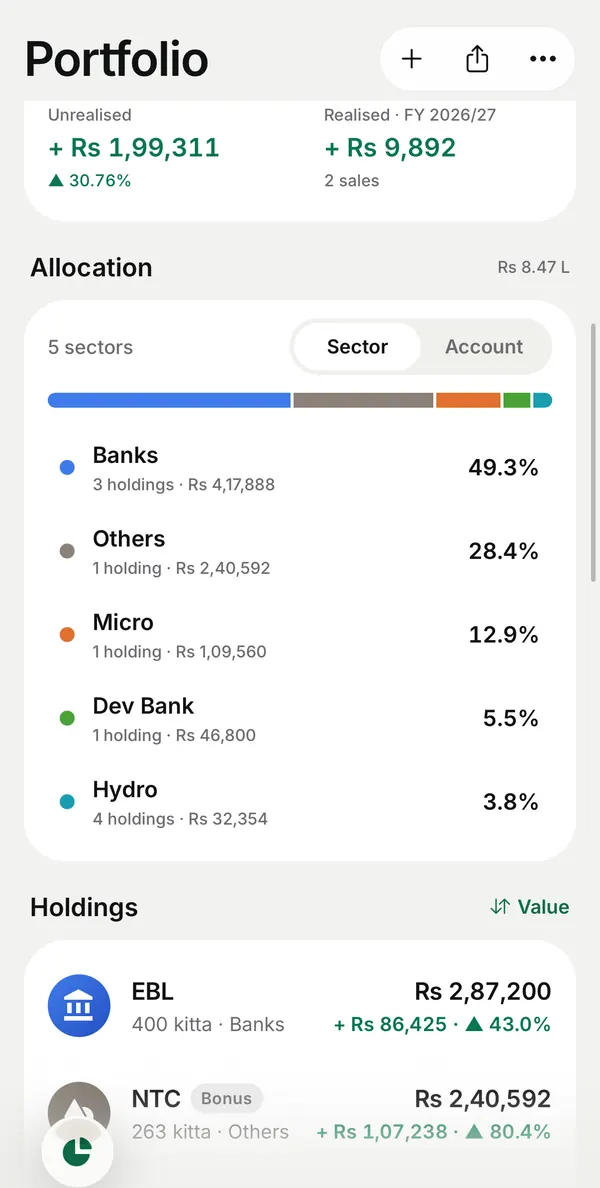
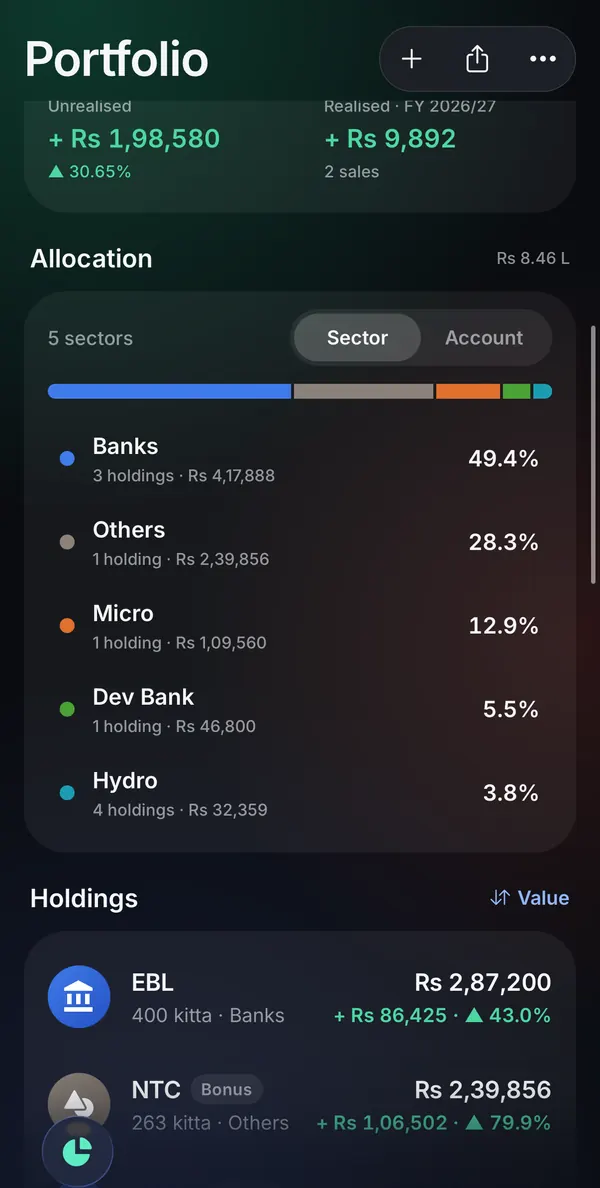
Punji app Portfolio: unrealised and realised gains, allocation by sector, and holdings with the gain on eachPunji app Portfolio: unrealised and realised gains, allocation by sector, and holdings with the gain on each
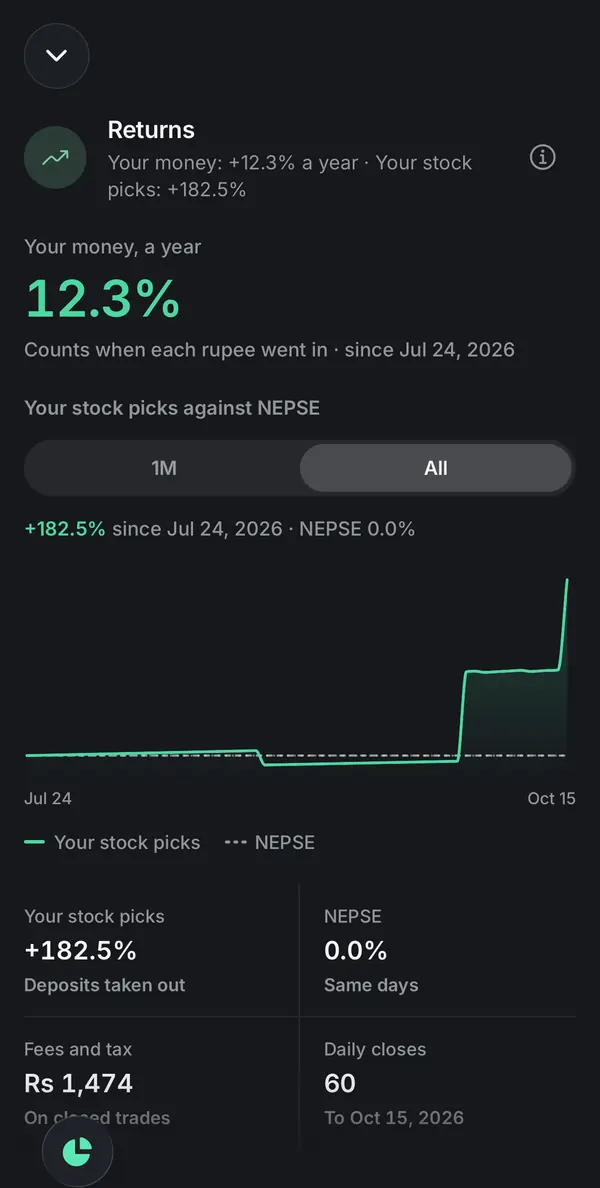
Punji app Returns: what your money earned a year, and your stock picks charted against NEPSEPunji app Returns: what your money earned a year, and your stock picks charted against NEPSE

The Punji app with a test account and sample holdings.

What it answers

Questions your portfolio should answer.

Value, return, risk, family and tax timing: the numbers that turn a list of holdings into a decision.

Returns

What did my money actually earn?

Two returns, side by side. Your money counts when you put cash in and took it out. Your picks leaves that timing out and measures only the shares you chose, against NEPSE.

  • A plain return until your first buy is a year old, then a rate per year
  • Cash dividends received count, after tax
  • Fees and tax on closed trades, added up
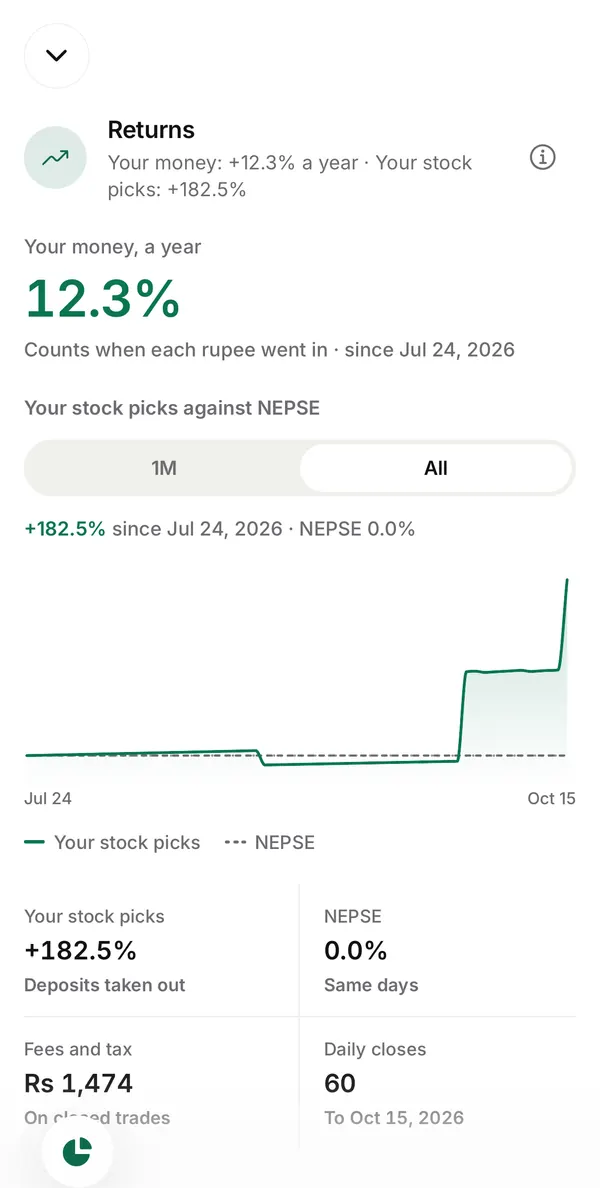
Punji app Returns: what your money earned a year, and your stock picks charted against NEPSEPunji app Returns: what your money earned a year, and your stock picks charted against NEPSE
Punji app Portfolio: unrealised and realised gains, allocation by sector, and holdings with the gain on eachPunji app Portfolio: unrealised and realised gains, allocation by sector, and holdings with the gain on each

Risk review

Where does my risk sit?

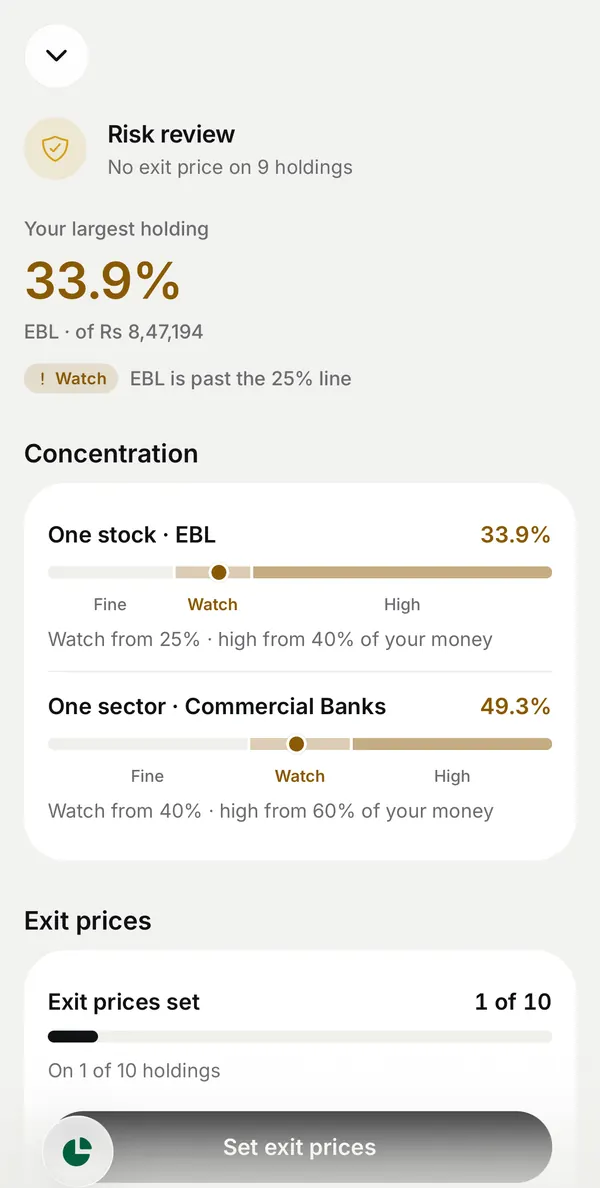
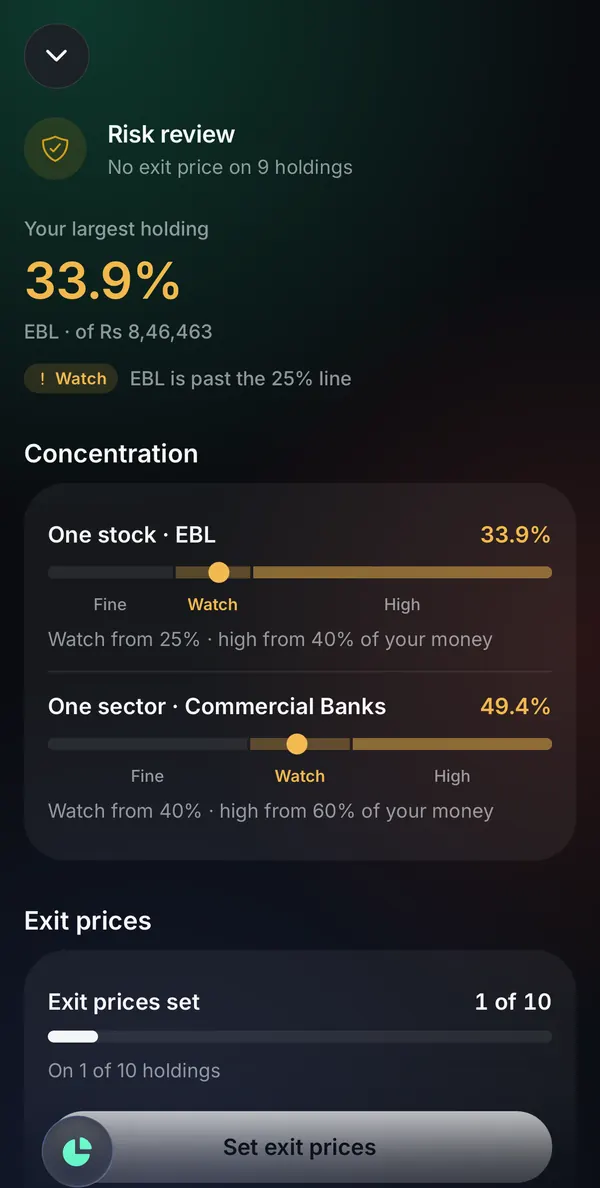
One stock and one sector against a Fine, Watch and High scale, and how many holdings have an exit price. Punji places no orders: an exit price is a note to yourself.

Punji app Risk review: the largest holding, one stock and one sector on a Fine, Watch and High scale, and exit prices setPunji app Risk review: the largest holding, one stock and one sector on a Fine, Watch and High scale, and exit prices set

Family

And the family’s?

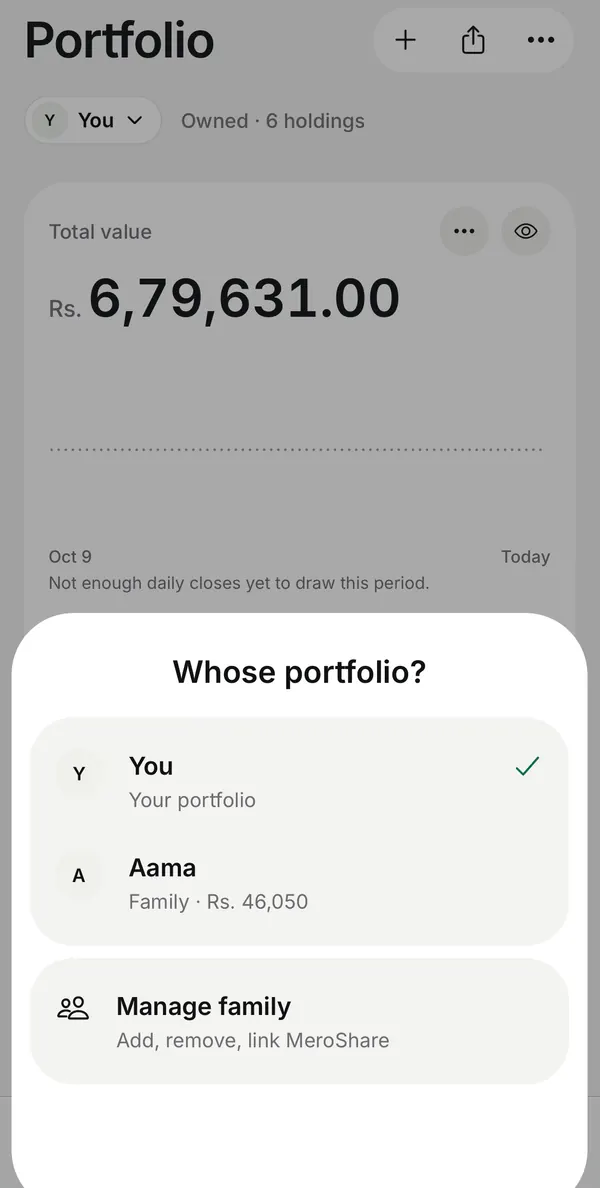
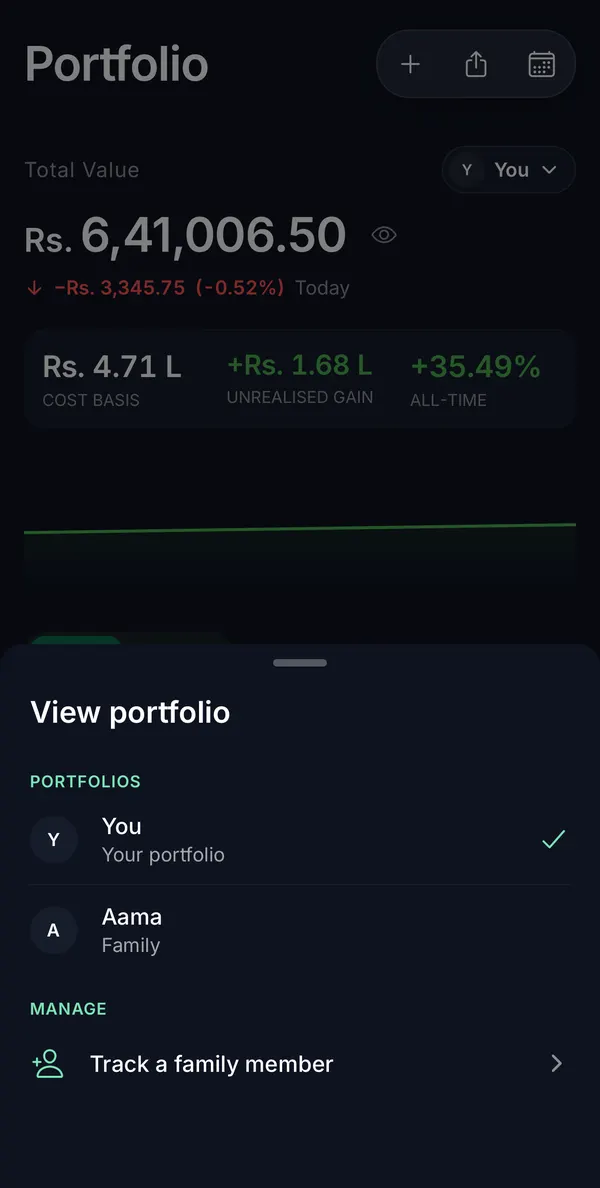
Keep a portfolio for each person you look after and switch from the top of Portfolio, in the app and at me.punji.app.

Punji app Portfolio with the portfolio switcher open: you, a family member, and a way to manage familyPunji app Portfolio with the portfolio switcher open: you, a family member, and a way to manage family

If sold today

What would a sale leave?

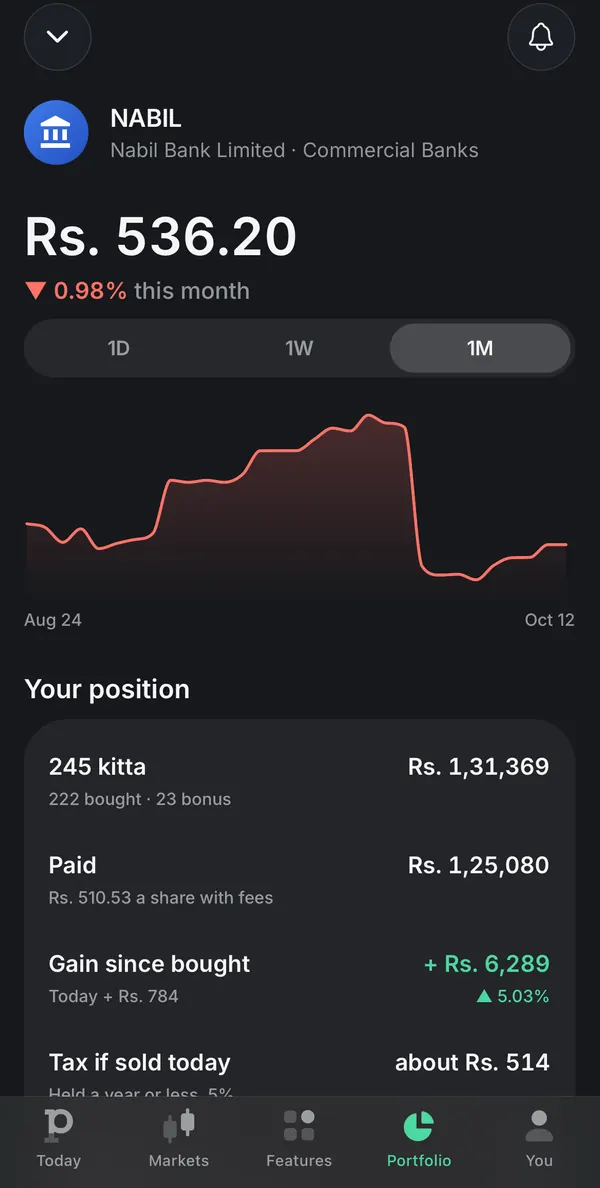
Each holding opens with what you paid, the gain since you bought and the tax a sale would carry.

Punji app holding card for NABIL: the price chart, kitta held, what was paid, the gain since bought and the tax if sold today

The CGT countdown, worked

Rs 327.43 for waiting a day.

200 shares bought at Rs 480.00, now worth Rs 615.00. Sell at day 365 and the gain is taxed at the short-term rate. Sell one day later and it is long-term. Nothing about the trade changes except the date, and Rs 327.43 stays with you.

Punji runs this for every profitable holding you own and shows the date, so the saving is not one you find out about afterwards. When you do sell, the tax summary is where the year’s total lands. Run any trade yourself in the calculators.

Sold on day 365: short-term

Gross sale
Rs 1,23,000.00
Commission, SEBON and DP
Rs 449.35
Capital gains tax5% on a gain of Rs 26,194.45
Rs 1,309.72
Net receivable
Rs 1,21,240.93

Sold on day 366: long-term

Gross sale
Rs 1,23,000.00
Commission, SEBON and DP
Rs 449.35
Capital gains tax3.75% on the same gain
Rs 982.29
Net receivable
Rs 1,21,568.36
Difference, for one day
Rs 327.43

CGT at the rates in force from 22 September 2026: 5% short-term, 3.75% long-term for a resident individual. Long-term means a holding of more than 365 days. Commission is tiered by trade value; the DP charge is Rs 25 flat per scrip per settlement.

How it works

Add once, check any time.

Bring your holdings in once. Punji tracks value, returns, risk and tax timing from there.

  • 1. Add your holdings

    Type them in, link MeroShare, or import a file. Family members are added the same way.

  • 2. See the value

    Value, day change and invested against returns, updated through market hours.

  • 3. Read your record

    Returns against NEPSE, the journal of closed trades, activity and the risk review.

  • 4. After a sale

    The journal records it with fees and tax, and the tax summary adds it to the year.

The tax year, added up

What the year’s sales cost you in tax.

Your broker deducts capital gains tax from each sale as it settles, so the year’s total is spread across contract notes. The tax summary in Punji puts it on one screen for the fiscal year, Shrawan to Asar: the tax on each sale at the rate for how long you held, the profit you took, and the gains and losses still open in what you kept.

It is an estimate for your own records, not a tax filing. Sales made before you imported from MeroShare are not in it, because the import brings across what you hold today.

An example year: two sales

200 shares held past a yearLong-term: 3.75% on a gain of Rs 26,194.45
Rs 982.29
100 shares sold inside the yearShort-term: 5% on a gain of Rs 11,287.60
Rs 564.38
Capital gains tax for the year
Rs 1,546.67
Profit kept after fees and tax
Rs 35,935.38

Made-up holdings, priced by the same fee engine as the app: 200 shares bought at Rs 480.00 and sold at Rs 615.00, and 100 bought at Rs 900.00 and sold at Rs 1,020.00. CGT at the rates in force from 22 September 2026 for a resident individual, after commission, SEBON fee and DP charge on both legs.

Questions

Portfolio questions, answered.

Want to understand capital gains tax? Read the CGT guide.

How do I track my NEPSE portfolio?

Bring your holdings in one of three ways: type in the symbol, quantity and cost price yourself, link your MeroShare account and let Punji bring them across, or import a file such as your MeroShare transaction history or a TMS trade book. From then on Punji shows the value of each holding, your day change, total invested and total return, updated through market hours, in the app and at me.punji.app.

Can it import holdings from MeroShare automatically?

Yes. Link your MeroShare account once and Punji brings your holdings across. Your cost price (WACC) comes with them once you have calculated it in the My WACC tab in MeroShare; MeroShare does not share it until then, and Punji tells you when that is the case. You can link accounts for your spouse, children or parents and switch between them from one screen. If you would rather not link an account, import your MeroShare transaction history as a file instead.

Does it show whether I am beating the market?

Yes. Returns compares your stock picks with the NEPSE index over the period you pick, and names the window it compared, so you see your gain next to the index gain over the same dates. If your portfolio is up 8% and NEPSE is up 5% over that window, you can see it at a glance.

Does it calculate XIRR?

Yes, under a plainer name. "Your money" is a money-weighted return, what a spreadsheet calls XIRR: it counts when you put money in and when you took it out, so adding cash just before a rally does not flatter the figure. "Your picks" is a time-weighted return, which leaves the timing of your deposits out and measures only how the shares you chose did. "Your money" is one figure over everything you have held: until your first buy is a year old it is the plain return since that day, because a return over a few weeks is not stretched into a yearly rate, and after that it is the rate per year.

What is the CGT countdown?

Capital gains tax in Nepal charges a higher rate on shares you sell within 365 days (short-term) and a lower rate on shares held longer (long-term). The CGT countdown shows, for each profitable holding, how many days remain until it qualifies for the lower long-term rate, and roughly how many rupees you would save by waiting.

Can it show my capital gains tax for the fiscal year?

Yes. The tax summary adds up the Nepali fiscal year, Shrawan to Asar: the capital gains tax on each sale at the rate for how long you held it, split into short-term and long-term, the profit you realised, and the gains and losses still open in what you hold. It is an estimate for your records, not a tax filing, and it covers sales recorded in Punji; sales made before you imported from MeroShare are not in it.

Does selling at a loss reduce my capital gains tax?

No. Capital gains tax in Nepal is worked out on each sale on its own and taken by your broker at settlement as a final tax, so a loss on one sale is not set against a gain on another. Selling something at a loss does not lower the tax on anything else you sold. You pay no capital gains tax on the losing sale itself, because there is no gain to tax. Punji shows you which holdings are below what you paid, and puts no tax figure beside them, because there is none to put.

What happens when a bonus or rights issue reaches a stock I hold?

After the book close, Punji works out what you are entitled to. A bonus is added to your portfolio only when you tap to apply it, and you can undo it until the end of that day. A fraction of a share the company settles in cash is shown, not added. A rights issue is shown so you know what you can apply for; you record rights shares as a purchase once you are allotted, because a rights entitlement is not yours until you apply and pay.

Can I track portfolios for the whole family?

Yes. Add each person under Family, then link their MeroShare or add their holdings by hand, and switch between portfolios from the top of Portfolio. Each one shows its own holdings and return. You do not need to log in and out each time.

Is my portfolio data private?

Yes. Your holdings, quantities and values are never shared with ad networks, and no other Punji user can see them. The app asks for your fingerprint, Face ID or phone passcode before it uses a saved MeroShare login, and the MeroShare and TMS account screens cannot be screenshotted. You can also turn on an app lock, and one tap on the eye icon hides your portfolio totals everywhere at once. The privacy policy lists what the app’s own analytics records.

Your portfolio, and what a sale would leave.

Free on the web, iOS and Android. MeroShare import, family portfolios, returns and the CGT countdown included.